Combining shapes
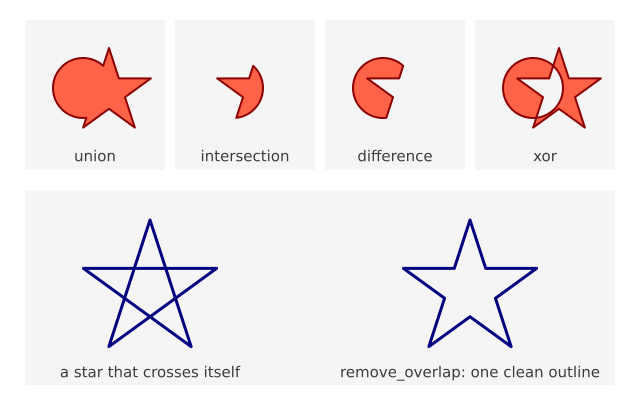
Two shapes can be joined, overlapped, cut and mixed with union, intersection, difference and xor. Each one gives back a new path. The bottom panel shows remove_overlap, which turns a crossing outline into one clean edge.
How it works
- f.path() starts an empty path. Its methods .circle() and .polygon() add a ring and a star outline to it.
- Four path methods combine two paths: union, intersection, difference and xor. Each gives back a new path and leaves the old ones alone.
- The example writes them as the operators | & - and ^. They mean the same as the four methods, in that order.
- f.draw_path() draws a path with the current fill and stroke. Combined paths are real shapes, so they can have holes.
- star_points() takes every second corner of a pentagon. The outline crosses itself, and path.remove_overlap() turns it into one clean edge.
- f.push(), f.translate() and f.pop() slide the clean copy to the right. The path itself does not change.
Make it yours
- Move the star: change cx + 14 in two_shapes() to cx + 40 and watch each result change.
- Swap the two paths in the difference: star - ring is not the same as ring - star.
- Replace the ring with f.path().rect(...) or f.path().ellipse(...).
- Cut a hole in a result with a third shape: (ring | star) - f.path().circle(x, y, 15).
- Fill a result with f.linear_gradient() instead of a flat colour.
The code
Copy it into a file and run it.
"""Combining shapes

Two shapes can be joined, overlapped, cut and mixed with union, intersection, difference and xor.
Each one gives back a new path. The bottom panel shows remove_overlap, which turns a crossing
outline into one clean edge.

How it works:
- f.path() starts an empty path. Its methods .circle() and .polygon() add a ring and a star outline
  to it.
- Four path methods combine two paths: union, intersection, difference and xor. Each gives back a
  new path and leaves the old ones alone.
- The example writes them as the operators | & - and ^. They mean the same as the four methods, in
  that order.
- f.draw_path() draws a path with the current fill and stroke. Combined paths are real shapes, so
  they can have holes.
- star_points() takes every second corner of a pentagon. The outline crosses itself, and
  path.remove_overlap() turns it into one clean edge.
- f.push(), f.translate() and f.pop() slide the clean copy to the right. The path itself does not
  change.

Make it yours:
- Move the star: change cx + 14 in two_shapes() to cx + 40 and watch each result change.
- Swap the two paths in the difference: star - ring is not the same as ring - star.
- Replace the ring with f.path().rect(...) or f.path().ellipse(...).
- Cut a hole in a result with a third shape: (ring | star) - f.path().circle(x, y, 15).
- Fill a result with f.linear_gradient() instead of a flat colour.
"""
import math

import funground as f


def star_points(cx, cy, r):
    """Every second corner of a pentagon, so the outline crosses itself."""
    return [(cx + r * math.cos(math.radians(-90 + i * 144)), cy + r * math.sin(math.radians(-90 + i * 144)))
            for i in range(5)]


def two_shapes(cx, cy):
    ring = f.path().circle(cx - 12, cy, 60)
    star = f.path().polygon(star_points(cx + 14, cy + 4, 44))
    return ring, star


def panel(x, label):
    f.fill(245)
    f.no_stroke()
    f.rect(x, 20, 140, 150)
    f.fill(60)
    f.text(label, x + 70, 156)


def setup():
    f.size(640, 400)


def draw():
    f.background("white")
    f.text_size(15)
    f.text_align("center", "center")

    names = ["union", "intersection", "difference", "xor"]
    for i, name in enumerate(names):
        x = 25 + i * 150
        ring, star = two_shapes(x + 70, 88)
        result = {"union": ring | star, "intersection": ring & star,
                  "difference": ring - star, "xor": ring ^ star}[name]
        panel(x, name)
        f.fill("tomato")
        f.stroke("darkred")
        f.stroke_width(2)
        f.draw_path(result)

    # remove_overlap: the same self-crossing star, before and after
    star = f.path().polygon(star_points(150, 290, 70))
    clean = star.remove_overlap()
    f.fill(245)
    f.no_stroke()
    f.rect(25, 190, 590, 195)
    f.no_fill()
    f.stroke("navy")
    f.stroke_width(3)
    f.draw_path(star)
    f.push()
    f.translate(320, 0)
    f.draw_path(clean)
    f.pop()
    f.fill(60)
    f.no_stroke()
    f.text("a star that crosses itself", 150, 372)
    f.text("remove_overlap: one clean outline", 470, 372)


f.run()